
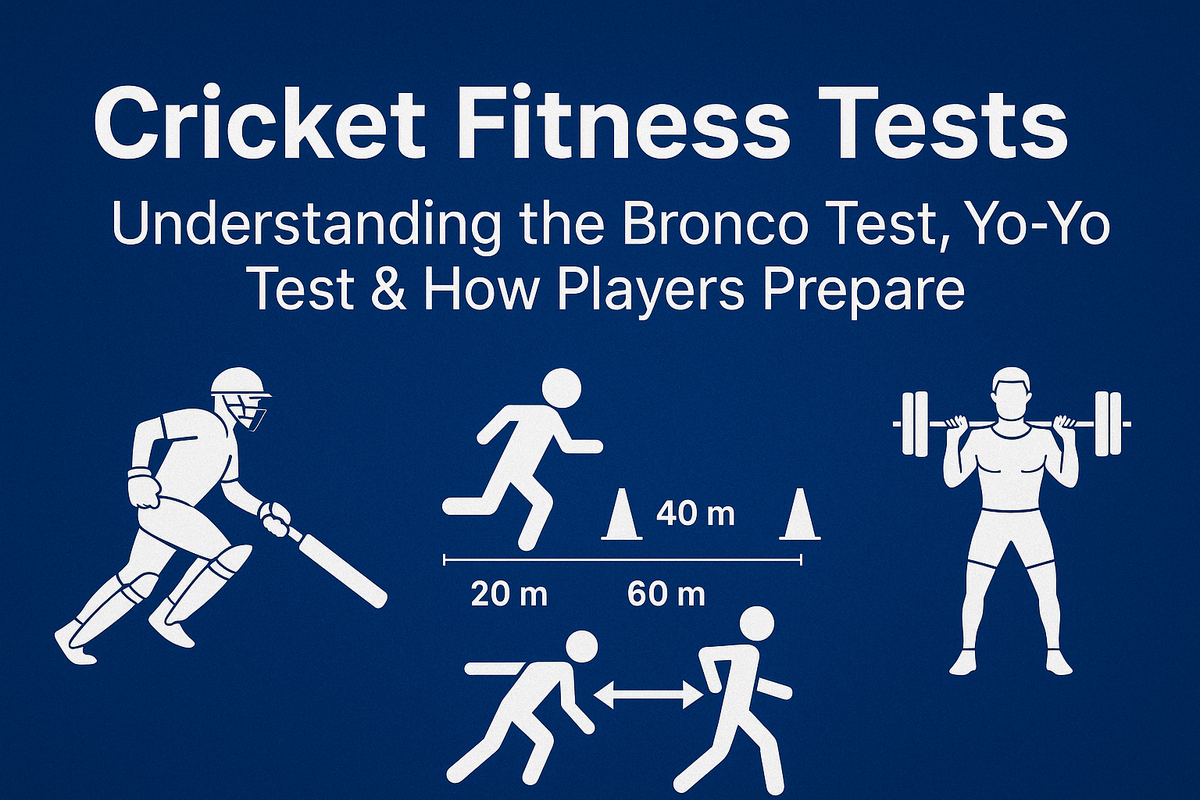
Introduction: Why Fitness Tests Are Crucial in Modern Cricket
Gone are the days when cricket was seen as a gentleman’s game played at a leisurely pace. The modern format, especially T20 and ODI, demands explosive power, quick reflexes, and relentless stamina. Players now sprint, dive, and bowl at top intensity multiple times in a single match.
To ensure every player meets the physical standards required for international cricket, cricket fitness tests like the Yo-Yo Test and the Bronco Test have become vital assessment tools for selection and performance monitoring.
What Are Cricket Fitness Tests?
Cricket fitness tests are structured assessments designed to measure a player’s stamina, endurance, recovery rate, and overall athletic readiness.
The main objectives are:
-
To maintain a high fitness benchmark across the squad
-
To prevent fatigue and injuries
-
To assess aerobic and anaerobic conditioning
-
To ensure players can sustain long spells in high-intensity situations
The BCCI (Board of Control for Cricket in India), like other international boards, regularly updates its testing protocols. In recent years, the focus has shifted from the Yo-Yo Test to the more rigorous Bronco Test a move designed to raise the bar even higher. These evolving standards aim to produce athletes who can compete with the fittest cricketer in the world, ensuring Indian players maintain world-class stamina, strength, and performance consistency.
The Bronco Test: BCCI’s New Benchmark for Endurance
What Is the Bronco Test?
The Bronco Test is a continuous shuttle-run fitness assessment originally used in rugby. It measures aerobic endurance and fatigue recovery, making it ideal for cricketers who face repeated bursts of running, bowling, and fielding.
In this test, players run a total of 1,200 metres in multiple sets without rest a true test of lungs, legs, and willpower.
How the Bronco Test Works
|
Step |
Distance (Metres) |
Details |
|
Set 1 |
20m out & back |
Start at line, sprint 20m, return |
|
Set 2 |
40m out & back |
Sprint 40m, return |
|
Set 3 |
60m out & back |
Sprint 60m, return |
|
1 Complete Set |
240m total |
20+40+60 (both directions) |
|
Total Required Sets |
5 continuous sets |
No breaks |
|
Total Distance |
1,200m |
Continuous running |
|
Target Time |
Under 6 minutes (elite benchmark) |
Top athletes aim below 5:45 |
Unlike the Yo-Yo Test, there are no rest intervals. This means the Bronco Test demands superior cardiovascular conditioning and mental resilience.
Why the BCCI Introduced the Bronco Test
According to reports, the BCCI adopted the Bronco Test to:
-
Eliminate the chance of players “gaming” the Yo-Yo Test’s pacing system
-
Measure real-time stamina without recovery intervals
-
Match global fitness standards set by countries like New Zealand and Australia
-
Promote a culture of year-round conditioning rather than pre-series fitness bursts
Even senior cricketers have admitted that the Bronco Test is “tougher and more transparent” than its predecessor.
The Yo-Yo Test: The Original Cricket Fitness Standard
What Is the Yo-Yo Test?
The Yo-Yo Intermittent Recovery Test was introduced to Indian cricket under coach Ravi Shastri and trainer Shankar Basu. It evaluates a player’s ability to recover between short sprints, mimicking the demands of running between wickets and quick fielding efforts. Alongside the test, players also focus on a gym workout for cricketers that builds strength, endurance, and agility, ensuring overall conditioning supports on-field performance.
How the Yo-Yo Test Works
-
Two cones are placed 20 metres apart.
-
The player runs from one cone to the other, in sync with beeps played through an audio track.
-
Each stage shortens the time between beeps, increasing the required running pace.
-
After each shuttle, the player gets a 10-second rest.
-
The test continues until the player fails to reach the cone twice in a row.
Scoring & Benchmarks
Most international teams set benchmark scores around 16.1 to 17.5, depending on age and role. For instance:
-
Virat Kohli and Hardik Pandya have consistently scored above 19 world-class levels.
-
Fast bowlers generally aim for 17+.
- Spinners and wicketkeepers are often tested with role-specific standards.
Bronco Test vs Yo-Yo Test: Key Differences
|
Feature |
Bronco Test |
Yo-Yo Test |
|
Test Type |
Continuous run |
Intermittent shuttle run |
|
Total Distance |
1,200 m |
Variable (depends on level reached) |
|
Rest Intervals |
None |
10 seconds between runs |
|
Focus Area |
Aerobic endurance & sustained pace |
Recovery ability between sprints |
|
Duration |
~6 minutes |
10–20 minutes depending on performance |
|
Transparency |
Harder to manipulate |
Can be paced strategically |
|
Adopted By |
BCCI (India), New Zealand Cricket |
ICC nations globally (India, Australia, England, etc.) |
While the Yo-Yo Test is great for measuring recovery efficiency, the Bronco Test pushes continuous stamina to the limit making it ideal for modern cricket’s fast-paced requirements.
Why Fitness Tests Matter in Cricket
-
Selection Standardization: Ensures all players meet a minimum conditioning level before representing the team.
-
Injury Prevention: Fit players are less prone to muscle strains and overuse injuries.
-
Performance Consistency: Improved recovery means players can maintain energy even after long spells.
-
Team Discipline: Encourages year-round fitness culture and accountability.
-
Scientific Monitoring: Trainers can track aerobic development and modify workloads accordingly.
A strong fitness benchmark reflects professionalism a reason teams like Australia, England, and India dominate modern formats.
How Cricketers Train for Fitness Tests
1. Endurance Runs
Players run 2–5 km at a steady pace to build aerobic capacity. Interval runs simulate fatigue during match conditions.
2. Shuttle Drills
Practicing 20/40/60m shuttle sprints improves acceleration and deceleration key in both the Bronco and Yo-Yo Tests.
3. Strength & Conditioning
Lower-body power, core stability, and explosive strength are built using squats, lunges, sled pushes, and plyometric jumps.
4. Mobility & Flexibility
Dynamic stretching and foam rolling improve recovery and reduce injury risk.
5. Nutrition & Recovery
High-protein diets, hydration, and adequate sleep ensure muscles recover quickly between high-intensity sessions.
Controversies Around Fitness Tests
Not everyone agrees with using a single test as a selection filter.
Critics like Sunil Gavaskar have argued that a “one-size-fits-all” approach ignores role-specific demands for example, a spinner’s endurance differs from a fast bowler’s.
However, supporters believe that uniform testing:
- Promotes fairness and professionalism
- Prevents complacency among senior players
-
Keeps fitness expectations transparent and measurable
The Future of Fitness in Indian Cricket
The Bronco Test may soon become the cornerstone of India’s player evaluation system. But experts suggest a hybrid approach combining Yo-Yo, 2 km time trials, and position-specific drills could be more holistic.
What’s clear is this: fitness will continue to play a decisive role in team selection and longevity. As cricket gets faster, stronger, and more data-driven, only the fittest will survive.
Key Takeaway
The Bronco Test represents a new era in cricket fitness testing, one that rewards endurance, honesty, and preparation. Whether you’re an aspiring cricketer or a coach, understanding these tests can help tailor training that matches professional standards.
Share:
Doctor-Approved Piles Exercises - Plus the Exercises to Avoid with Hemorrhoids
What Are Football Shoes Called? (Boots, Cleats & Everything You Need to Know)